Two Buildings
In 1908 Walter Winans won an Olympic gold medal for shooting. In 1912 he won another for sculpture. For thirty six years the Games awarded medals in art alongside sport, until an amateurism rule ended it in 1949. The separation of the athlete from the artist is administrative rather than biological, and the evidence on practice, attention and perception suggests both disciplines are working on the same system.
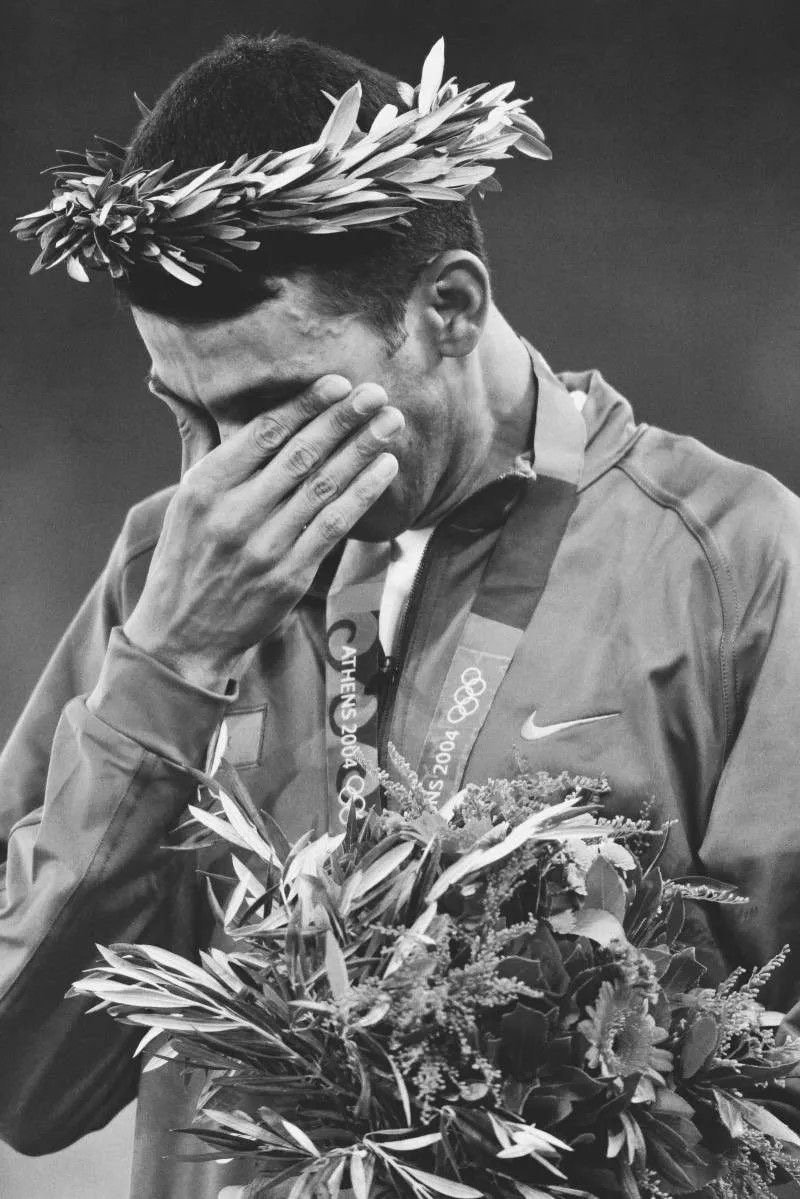
In 1908, Walter Winans won an Olympic gold medal with a gun. Four years later, he won another with a sculpture.
The first came in the running-target shooting event at the London Games. The second came in Stockholm for An American Trotter, a small bronze sculpture of a horse. Today, those achievements feel as though they belong to two different people.
They did not.
For thirty-six years, the modern Olympic Games awarded medals in architecture, literature, music, painting, and sculpture alongside running, wrestling, swimming, and shooting 15. The works had to be inspired by sport and previously unpublished. This was not an exhibition attached to the Games. It was competition.
Then, in 1949, the International Olympic Committee ended it. The reason was almost absurdly administrative. Most of the artists were professionals. Olympic athletes were still required to be amateurs. So art disappeared from the Games because the artists were being paid.
A bureaucratic rule became a cultural boundary. Eventually, we forgot the boundary had ever been invented. We built one place for athletes and another for artists. One person developed the body; another developed expression. Strength belonged to the gym. Creativity belonged to the studio. Repetition became mechanical in one building and artistic in the other.
The human nervous system seems considerably less interested in those distinctions. And once you begin looking underneath the disciplines rather than at their costumes, the separation becomes difficult to defend.
A pianist repeating scales, a boxer repeating combinations, a dancer repeating turns, a basketball player repeating footwork, and a sculptor refining the same form may appear to be practicing entirely different crafts. At the level of the human system, they are solving many of the same problems.
How do you organize attention? How do you reduce error? How do you turn deliberate action into something that can be executed without constant supervision? How does repeated experience alter what you are capable of perceiving? And after thousands of repetitions, what exactly has practice given back to you?
That last question is more complicated than it first appears.
I. WHAT REPETITION ACTUALLY DOES
One of the most familiar stories in motor learning goes like this. At first, a movement requires conscious control. You have to think about the sequence, the timing, the position of the body, what comes next, what just went wrong. With enough repetition, the movement becomes automatic. The brain needs less active supervision. Attention is freed.
Anyone who has practiced a skill long enough recognizes the subjective version of this transition. The first time you drove a car, changed gears, played a chord, threw a combination, or learned a dance sequence, the task consumed you. Later, parts of it seemed to disappear. You simply did them.
A classic brain-imaging experiment published in 2005 appeared to show exactly that 1. Fourteen young adults learned a serial reaction-time sequence and were scanned before and after several hours of training. As the trained sequence became more automatic, activation decreased in regions including the supplementary motor area, putamen, and globus pallidus. Importantly, the reduction was specific to the trained sequence rather than random movements. It looked like the nervous system had learned to run the pattern more cheaply. That paper became part of the scientific foundation beneath the intuitive idea that practice frees attention.
Then, in 2026, a larger study complicated the story 2. Eighty-seven people practiced motor sequences across ten sessions. Rather than finding that the learned sequence became progressively less demanding under a second-task condition, the researchers found the opposite. Dual-task cost for the practiced sequence increased by 112 milliseconds. The better some participants learned the sequence, the greater the sequence-specific attentional cost became. The authors proposed that richer and more explicit representations of the practiced sequence may remain actively maintained rather than simply dropping out of conscious processing.
The newer experiment does not prove the older one wrong. The tasks were different. The measures were different. Neither involved an athlete, artist, or complex real-world skill. But together they destroy the clean version of the story. Practice does something to attention. What it does may depend on how the practice is built.
That distinction matters enormously, because repetition itself is cheap. Anyone can repeat something. You can rehearse an error for ten years. You can become extraordinarily consistent at producing the wrong solution. You can also learn a movement while remaining so cognitively attached to its components that the movement never becomes available for anything beyond itself.
The question is therefore not simply whether you practiced. It is what the practice required your nervous system to encode. What information became important? What errors were corrected? What sensations became meaningful? What remained under deliberate supervision? What was eventually allowed to organize itself?
This is where coaching becomes more than the delivery of exercises. If repetition automatically converted effort into automaticity, there would be little reason for a coach to exist. The architecture of practice matters because the adaptation is partly an adaptation to the practice environment itself.
And there are other experiments suggesting that something important does change as learning progresses. In one study, researchers had people learn a reaching task while irrelevant stimuli were presented and measured through EEG 3. Early in learning, the participants' neural response to those irrelevant stimuli was relatively suppressed. The task occupied them. As practice accumulated, their response to the irrelevant information increased. Some attentional capacity appeared to have returned.
A 2025 experiment found a related change in subjective experience 4. Participants practicing learned motor sequences reported decreasing effort as sequence-specific learning improved. Random sequences also became faster. But they did not feel easier.
That is a subtle difference with enormous implications. Performance improved in both cases. The internal cost did not. Speed alone was therefore insufficient to tell you what had actually changed in the system.
This may be one reason experienced performers pay so much attention to how something feels. Not because feeling is infallible. It is not. But because effort sometimes reveals something that the stopwatch cannot. A movement that still has to be assembled consciously carries a different internal texture from one whose components have begun to organize together.
Eventually, separate pieces become chunks. You stop experiencing every letter and begin experiencing the word. You stop experiencing every note and begin experiencing the phrase. You stop experiencing each joint position and begin experiencing the action.
And once that happens, the interesting question changes. It is no longer simply whether you can perform the skill. It becomes what you can do with the attention the skill no longer consumes.
II. THE PRICE OF EXPRESSION
In 2008, six professional jazz pianists improvised inside an fMRI scanner 5. The sample was tiny. All six were men. Brain imaging can show correlation but cannot tell us that a particular pattern of activation causes creativity. Those limitations matter. But what happened is still worth understanding.
During improvisation, activity decreased in parts of the dorsolateral prefrontal and lateral orbital cortex associated with self-monitoring and deliberate evaluation. At the same time, medial prefrontal regions associated with internally generated behavior became more active while the sensorimotor system continued doing the actual playing. A later study of freestyle rappers found a similar broad dissociation 6. The performers were generating complex output while some of the machinery associated with monitoring that output became quieter.
The important part is who these people were. Professionals. They had already accumulated the vocabulary. Their hands knew the instrument. Their nervous systems contained thousands of practiced relationships between rhythm, sound, timing, force, expectation, and error. Conscious control could loosen because something underneath it was capable of carrying the performance.
A novice cannot simply imitate that state. Tell someone who has never played piano to stop thinking and express themselves and you have not liberated them. You have removed the only thing currently holding the task together.
Freedom at the top of a discipline therefore depends on constraint at the bottom. The scale comes before the solo. Footwork comes before improvisation. Grammar comes before poetry. A painter develops control of the hand before the hand becomes capable of surprising them. A boxer spends thousands of repetitions learning distance, balance, rhythm, guard position, weight transfer, and timing before those pieces can disappear inside a fight.
This is one reason mastery often looks effortless from the outside. The effort has not vanished from the person's history. It has been metabolized into capability. The visible performance is the residue of invisible repetition.
Which makes repetition something more interesting than discipline for its own sake. Repetition purchases options. It expands the number of things the system can do without collapsing. And eventually, those options become the material from which expression is built.
But the scientific disagreement at the center still matters. We cannot simply say that practice always frees attention. Sometimes it may. Sometimes richer learning may keep more of the representation actively available. The more defensible conclusion is narrower and more useful: practice reorganizes the relationship between attention and action, and the structure of practice helps determine what that relationship becomes.
The artist and the athlete are both manipulating that relationship. One calls the outcome expression. The other calls it performance.
The nervous system may not care.
III. YOU WATCH WITH YOUR TRAINING
Practice changes what you can do. More strangely, it changes what you can see.
Researchers once showed basketball free throws to elite players, basketball coaches and sports journalists, and novices 7. The elite players could predict whether the shot would go in earlier and more accurately than the others. The divergence appeared before the ball had left the shooter's hand. They were not waiting for the trajectory. They were reading the body.
The coaches and journalists are what make the finding interesting. They had accumulated enormous amounts of basketball viewing. They had visual expertise. What they did not possess to the same degree was the motor history of the elite players. The athletes' bodies had lived inside the movement they were watching, and their perception contained information the viewers could not extract.
The brain stimulation results were more nuanced than the simplified version of this finding usually suggests. Coaches and journalists did show motor-system resonance while watching. But only the athletes showed the same time-specific motor response to erroneous throws alongside the behavioral prediction advantage. Their motor system seemed able to detect something about the unfolding mistake. Their body had become part of the instrument through which the movement was perceived.
A separate experiment produced an almost surgical version of the same idea 8. Professional ballet dancers and professional capoeira dancers watched both ballet and capoeira movements while undergoing fMRI. Each group served as the other's control. The movements were still human bodies. The viewers were still professional movers. But ballet dancers showed stronger activation in premotor and parietal regions while watching ballet, while capoeira dancers showed the corresponding advantage while watching capoeira. The difference was not whether the observer respected or understood movement generally. It was whether their own body could perform that particular vocabulary.
Expertise had altered perception. A pianist hears differently because they have played. A fighter reads distance differently because they have stood inside it. A dancer sees balance differently because they have lost and recovered it thousands of times. A sculptor sees proportion differently because they have tried to reproduce it.
You do not merely accumulate knowledge about a discipline. You become a different instrument for perceiving it.
This may even reach into aesthetics. In another experiment 9, dance-naive participants watched ballet movements and rated both how much they liked them and how physically capable they believed themselves to be of reproducing them. Across participants, perceived difficulty and aesthetic evaluation showed a modest inverse relationship: movements judged harder to reproduce tended, on average, to be judged more beautiful.
It was not a universal law. The relationship varied substantially between people, and the experiment measured perceived ability rather than actual ability. But it adds another layer to the same idea. What we experience as beauty may not be detached from what our own body believes is possible. The body may participate in aesthetic judgment. And when people receive physical training on actions, their subsequent experience of watching those actions can change.
Doing changes seeing. Watching alone does not necessarily do the reverse.
This has uncomfortable implications for an age in which we consume enormous amounts of expertise through screens. Watching a movement explanation can sharpen attention. It can tell you what to notice. It can give language to something you were already sensing. But it cannot install the experience. A thousand videos about balance do not produce balance. A thousand breakdowns of rhythm do not create rhythm. Information can point toward perception. Embodied experience builds it.
That means even the best educational content ultimately has to fail in a useful way. It should make the viewer aware of what they cannot understand until they go and do something.
IV. ORGANIZED DIFFICULTY
If the athlete and artist share anything deeper than aesthetics, it may be this: both provide a socially accepted way to spend years confronting things you cannot yet do.
There is always another phrase you cannot quite play. Another position you cannot quite hold. Another movement you cannot quite time. Another idea your hands cannot yet produce. Another layer of perception you are not yet sensitive enough to detect.
A discipline organizes failure. And because the difficulty has a name, boxing, ballet, piano, sculpture, basketball, you are willing to return to it.
There is an interesting experiment on older adults that has almost nothing to do with either sport or art and therefore helps clarify this point. The Synapse Project randomized older adults into six conditions 10. Some learned digital photography. Some learned quilting. Some learned both. Another group participated in a social club that provided time, activity, and human contact without the same demand to master a difficult new skill. There were also additional control conditions.
Two hundred fifty-nine people enrolled. Two hundred twenty-one completed the fourteen-week intervention. Actual engagement averaged more than sixteen hours per week. The productive-engagement conditions improved episodic memory relative to the more receptive conditions. The social group did not show significant improvement on that outcome.
The point is not that socializing is neurologically useless. It is not. The point is that when researchers tried to separate time, novelty, company, and activity from the demand to acquire a difficult new skill, sustained productive difficulty survived the comparison. Photography and quilting are not magical. They were useful because participants had to continue building something they could not already do.
That may be one of the deepest technologies contained inside any serious discipline. A discipline keeps you close to the edge of your current capacity without making that failure meaningless. It gives you a reason to come back.
This is where the romantic claims around art and movement need to be handled carefully. Dance is frequently described as uniquely protective for the aging brain because it combines cardiovascular exercise, coordination, rhythm, memory, spatial navigation, and social interaction. The theory is plausible. The comparative evidence is less dramatic.
A 2026 Bayesian network meta-analysis 11 examined 209 articles from 172 unique studies involving 13,773 participants with mild cognitive impairment or dementia. Dance performed better than control conditions. But when compared against other active interventions, the authors found no statistically significant advantage for dance over other exercise modalities on any of the twelve outcomes examined. Some rankings favored dance, but several were driven by a single study, and rankings are not the same thing as statistically significant differences.
That does not make dance unimportant. It changes where the advantage may actually live. Dance may not contain a unique neurobiological ingredient. It may contain something more practical: people love doing it. They return. They form identities around it. They meet other people through it. They tolerate complexity because the complexity has meaning.
Adherence is not a boring variable sitting outside the intervention. Over decades, adherence is the intervention. The modality that people repeatedly return to gets opportunities to change them that the theoretically superior modality abandoned after three weeks never receives.
Music produces a similar evidence problem. A large 2025 observational study 12 followed 10,893 older Australians and found that people who reported frequently listening to music had lower rates of dementia, while frequent instrument playing was also associated with lower risk. Those numbers make good headlines. They do not establish that music prevented dementia.
People entering a long prodromal phase of neurodegenerative disease may stop demanding hobbies before they receive a diagnosis. Education differed across the associations. People who maintain musical practice late in life may differ from those who do not in dozens of ways that are difficult to fully measure. The instrument-playing result barely crossed the conventional threshold for statistical significance. The association is worth studying. It is not a prescription.
Put that observational study beside the Synapse trial and the more interesting lesson appears. Ten thousand people can give you a weaker causal answer than two hundred people placed into a properly controlled experiment. The number of participants matters. The design determines what the number is allowed to mean. And that distinction has become increasingly important in a culture that consumes scientific conclusions without consuming the architecture that produced them.
V. THE BODY AS A SPECIFICATION
Long before neuroscience could watch a motor system learning, artists were already treating the body as something that could be measured, modeled, reproduced, and refined.
The sculptor Polykleitos wrote a treatise called the Kanon. The word means measure, rule, or standard. The text is lost. Its physical argument survives in sculpture. The Doryphoros was not simply an image of an attractive body. It was a demonstration of proportion.
Modern laser analysis of sculpture associated with Polykleitos and his followers suggests something even more systematic 13. Researchers scanning surviving works and plaster casts at an accuracy of plus or minus fifty micrometers found relationships consistent with a workshop process built around models, molds, predictable material shrinkage, and controlled changes of scale. Some works were roughly three percent smaller than related forms. Another was approximately seven percent smaller. Clay shrinks as it dries. Bronze shrinks as it cools. The researchers argue that these material constraints may have been incorporated into the workshop's production logic.
The idea of the ideal body starts to look surprisingly similar to an engineering specification. A template. A constraint. A desired relationship between parts. Known sources of error. Replication. Variation. Correction. Another iteration.
That is training. A training program is also an attempt to produce adaptation from a specification without pretending every body begins in the same place. The model has to survive contact with the individual. Too rigid and it breaks the person. Too vague and it produces nothing. The process is always negotiating between an ideal and a material reality.
Which is why the distinction between art and sport becomes weaker the closer you move toward process. Both involve engineering under constraints. Both require sensitivity to proportion. Both depend on feedback. Both turn error into information. Both eventually produce an outcome that appears less mechanical than the process that created it.
The written Kanon disappeared. The embodied demonstration survived. There is something fitting about that. Theory is fragile. The thing a body learns can persist without language.
VI. BEFORE THERE WERE TWO BUILDINGS
Around 220 CE, a trainer named Philostratus opened the only surviving ancient treatise devoted specifically to athletic training with an argument 14. Athletic training, he wrote, should be regarded as a sophia no less than any other techne. A form of wisdom no less than another craft.
He was not a philosopher admiring athletics from the outside. He was defending the trainer's own discipline. And the argument mattered because physicians such as Galen had questioned whether athletic training constituted legitimate knowledge at all.
Who understands the body? The physician? The trainer? The philosopher? The person who studies it? The person who repeatedly changes it?
That jurisdictional fight is nearly two thousand years old, and it is still recognizable. Coaching is often treated as a service profession that borrows legitimacy from disciplines considered more intellectual. Medicine owns pathology. Biomechanics owns measurement. Neuroscience owns the brain. Psychology owns behavior. The coach is left with application.
But application is itself a knowledge problem. A coach has to decide which information matters for this person, under these conditions, at this moment, with this history, this fatigue, this goal, and this tolerance for failure. The scientific paper rarely contains that answer. Neither does the exercise. The knowledge lives in the decision.
Philostratus understood that the trainer was not merely administering movement. The trainer was interpreting a human being.
Which brings us back to Walter Winans. Gold in shooting. Gold in sculpture. Four years apart. The strangeness belongs mostly to us. For him, the categories could apparently coexist inside one life.
Then an institution changed its rules. Artists were professionals. Athletes were supposed to be amateurs. The competitions ended. The administrative distinction persisted. And over time, the wall became so familiar that we began treating it as a description of human nature.
It never was.
THE HYPE GAP
There is a reason I want this newsletter to contain the findings that weaken its own argument. Good ideas become dangerous when every piece of evidence is recruited to support them. So here are four claims currently circulating much farther than the evidence allows.
"Dance uniquely protects the aging brain."
The comparative evidence does not currently support that. Dance performs better than doing nothing in many studies, but the 2026 network analysis found no statistically significant advantage over the other active modalities across any of twelve outcomes. That does not make dance useless. It means we should stop inventing a special neurological property when adherence, enjoyment, complexity, and social structure may already explain why it works so well in real life.
"Taurine declines with age, so replacing it is anti-aging."
The premise itself has become unstable. A National Institute on Aging analysis published in Science in 2025 16 found that circulating taurine generally rose or remained stable with age across humans, monkeys, and mice rather than showing the universal decline the popular narrative requires. The earlier mouse lifespan findings were not erased. The simple human story built around age-related taurine depletion was.
"The FDA approved BPC-157."
It did not. In July 2026, an FDA advisory committee voted to recommend BPC-157 for inclusion on the 503A bulk-substances list used in compounding. That recommendation is nonbinding. Compounding eligibility is not drug approval. The available human evidence remains limited, and BPC-157 remains prohibited in sport. Three words, "FDA approved BPC," turn several different regulatory processes into one false statement.
"Semaglutide reversed biological age by five years."
A randomized placebo-controlled trial did report changes in DNA-methylation aging clocks 17. But the analysis involved 84 adults with HIV-associated lipohypertrophy, lasted thirty-two weeks, and the epigenetic analysis was post hoc. A methylation clock is a statistical surrogate. It is not mortality. It is not function. It is not an additional five years of life. The study is interesting. The headline is a different study.
THE FIELD
The human-performance world is changing outside the laboratory too. A few developments this month matter.
YouTube changed the ruler. On August 24, YouTube changed how a view is counted so that playback from the first frame can register a view across formats. That means apparent performance changes around the rollout may partly reflect a measurement change rather than an audience change. Whenever a platform changes the metric, historical comparison becomes dangerous. You cannot improve what you are measuring if the ruler itself moved.
Short-form economics are getting harsher. YouTube also announced higher Partner Program thresholds taking effect in 2027, while preserving the economics of long-form content more clearly than Shorts. The direction is difficult to miss. Short-form remains an extraordinary discovery engine. It is becoming an increasingly unforgiving business model when treated as the destination. Attention is cheap. Depth is where the economic relationship becomes more defensible.
Platforms are becoming more aggressive about originality. Instagram is increasingly using systems intended to identify reused and cross-platform content, while distribution incentives continue moving toward native material. Whether every reported percentage circulating around the change proves accurate is less important than the direction of travel. Platforms want content that appears to originate inside their own ecosystem, and creators who treat every platform as a dumping ground for the same exported file are gradually paying for the convenience.
Health information has moved into the feed. Pew identified thousands of large health and wellness creators across major social platforms and found that a substantial portion of American adults now receive health information from them. That creates an unusual epistemic environment. A creator can reach more people in a week than many researchers will address in an entire career, and the creator often has fewer formal constraints. That makes visible reasoning increasingly important. Authority cannot simply be performed through vocabulary. The audience needs to see how a conclusion was reached, what the evidence can support, and where it stops.
"AI that adapts" is becoming commodity language. Fitness companies are increasingly using the same vocabulary: personalization, adaptive programming, intelligent coaching, an AI that behaves more like a coach than a static workout application. That means adaptation itself will not remain a meaningful differentiator for long. The valuable asset becomes the logic underneath the adaptation. Whose judgment is being encoded? What does the system notice? What changes the decision? What does it refuse to change? What model of the human being is contained inside the software? The future competitive advantage may not be that a product uses AI. It may be that the product can explain whose mind the AI learned to imitate.
WHAT CHANGED WHILE I WAS RESEARCHING THIS
This edition produced more corrections than most. That is worth showing because the corrections are part of the work.
A claim that a meta-analysis found resistance training improved judged ballet technique scores turned out to be false. The review explicitly states that a meta-analysis of aesthetic competence could not be performed. The circulating claim appears to trace back to one primary study from 1990.
A 2026 dance network meta-analysis contains a typographical error in its own abstract, reporting 3,773 participants even though the results section and participant breakdown show 13,773.
A story about Eugen Sandow measuring specific classical statues to derive his "Grecian Ideal" is repeatedly attached to a Natural History Museum source that does not actually support the claim.
The Synapse Project is often described as two groups over three months at fifteen hours per week. It was six arms, fourteen weeks, with actual average participation of 16.51 hours per week.
The total number of Olympic art medals awarded between 1912 and 1948 cannot be stated confidently because different sources give different totals and the IOC does not maintain a complete medalist database for those competitions.
And the cleanest scientific claim in this entire edition, that practice makes a movement automatic and frees attention, is contradicted directly by a larger 2026 experiment. That last one is my favorite correction, because the contradiction does not weaken the subject. It makes it more alive.
THE CONNECTION
Sport and art are not interesting because they occasionally resemble each other. They are interesting because beneath their cultural identities they repeatedly ask the human system to solve the same class of problem.
Both begin with attention. Both organize repetition. Both create errors and require the performer to become sensitive enough to detect them. Both alter perception through experience. Both demand periods of deliberate control. Both eventually confront the question of when that control should recede. Both can hold someone at the edge of their current ability for decades. And both can transform something mechanical into something personal.
The mistake would be turning this into another romantic claim about humans once being whole until modernity separated us. History is rarely that neat. The more useful observation is narrower. Our categories are cultural. The mechanisms underneath them are biological.
The nervous system does not know that a rehearsal room and a weight room are supposed to contain different kinds of people. It knows constraints. It knows prediction. It knows error. It knows adaptation. It knows attention. It knows what has been repeated enough times to become available. And it knows what still costs too much to perform.
The person performing inside that system eventually gives the process a name. Athlete. Musician. Dancer. Painter. Coach. Sculptor. Those identities matter. They create communities, traditions, histories, methods, and standards. But they should not obscure the underlying continuity.
Walter Winans could win an Olympic gold medal shooting a moving target and another sculpting a horse because there was never anything biologically incoherent about those two capacities living in the same person. We are the ones who learned to find it strange.
The most interesting thing practice may eventually return is therefore not automaticity. It may be possibility. A larger vocabulary of actions. A finer perceptual instrument. More sensitivity to error. More ways to respond. More space between stimulus and decision. More freedom to produce something that was not explicitly rehearsed.
We still do not know exactly how attention changes as a skill becomes deeply learned. The best studies currently disagree. That uncertainty should remain. It prevents the philosophy from pretending to be a mechanism. But we know enough to say something useful. Repetition changes the performer. Experience changes perception. Difficulty, sustained long enough, reorganizes capacity. And technique becomes most powerful when it no longer has to announce itself.
There are still two buildings.
You simply do not have to believe in the wall.

References
- [1] Russell A. Poldrack, Fred W. Sabb, Karin Foerde, Sabrina M. Tom, Robert F. Asarnow, Susan Y. Bookheimer, Barbara J. Knowlton (2005). The Neural Correlates of Motor Skill Automaticity. Journal of Neuroscience.
- [2] Stephan F. Dahm, Vanessa Kraft, Markus Martini, Daniel Krause, Joachim Hermsdoerfer (2026). Motor Sequences Resist Automatization as Attentional Demands Increase with Sequence Learning. npj Science of Learning.
- [3] Jeremy C. Rietschel, Craig G. McDonald, Ronald N. Goodman, Matthew W. Miller, Lauren M. Jones-Lush, George F. Wittenberg, Bradley D. Hatfield (2014). Psychophysiological Support of Increasing Attentional Reserve During the Development of a Motor Skill. Biological Psychology.
- [4] Bahar Ghafari Goushe, Thibault Mangin, Benjamin Pageaux, Jason L. Neva (2025). Perception of Effort Decreases with Motor Sequence Learning. Scientific Reports.
- [5] Charles J. Limb, Allen R. Braun (2008). Neural Substrates of Spontaneous Musical Performance: An fMRI Study of Jazz Improvisation. PLOS ONE.
- [6] Siyuan Liu, Ho Ming Chow, Yisheng Xu, Michael G. Erkkinen, Katherine E. Swett, Michael W. Eagle, Daniel A. Rizik-Baer, Allen R. Braun (2012). Neural Correlates of Lyrical Improvisation: An fMRI Study of Freestyle Rap. Scientific Reports.
- [7] Salvatore M. Aglioti, Paola Cesari, Michela Romani, Cosimo Urgesi (2008). Action Anticipation and Motor Resonance in Elite Basketball Players. Nature Neuroscience.
- [8] Beatriz Calvo-Merino, Daniel E. Glaser, Julie Grèzes, Richard E. Passingham, Patrick Haggard (2005). Action Observation and Acquired Motor Skills: An fMRI Study with Expert Dancers. Cerebral Cortex.
- [9] Emily S. Cross, Louise Kirsch, Luca F. Ticini, Simone Schütz-Bosbach (2011). The Impact of Aesthetic Evaluation and Physical Ability on Dance Perception. Frontiers in Human Neuroscience.
- [10] Denise C. Park, Jennifer Lodi-Smith, Linda Drew, Sara Haber, Andrew Hebrank, Gérard N. Bischof, Whitley Aamodt (2014). The Impact of Sustained Engagement on Cognitive Function in Older Adults: The Synapse Project. Psychological Science.
- [11] Yang Zhao, Dong Tao, Bo Zhao, Wei Li, Xin Lv, Shuai Shao, Yan Sun, Xin Zhao, Alistair Cole, Yang Gao (2026). Dance versus Other Exercise Modalities in Mild Cognitive Impairment and Dementia: Comparative Efficacy from a Systematic Review and Bayesian Network Meta-Analysis. Frontiers in Physiology.
- [12] Emma Jaffa, Zhaoli Wu, Alice Owen, Aung Zaw Zaw Phyo, Robyn L. Woods, Suzanne G. Orchard, Trevor T.-J. Chong, Raj C. Shah, Anne Murray, Joanne Ryan (2025). What Is the Association Between Music-Related Leisure Activities and Dementia Risk? A Cohort Study. International Journal of Geriatric Psychiatry.
- [13] Kyoko Sengoku-Haga, Sae Buseki, Min Lu, Shintaro Ono, Takeshi Oishi, Takeshi Masuda, Katsushi Ikeuchi (2017). Polykleitos and His Followers at Work: How the Doryphoros Was Used. Artistry in Bronze: The Greeks and Their Legacy, J. Paul Getty Museum.
- [14] Philostratus, edited and translated by Jeffrey Rusten and Jason König (2014). Heroicus. Gymnasticus. Discourses 1 and 2. Loeb Classical Library 521, Harvard University Press.
- [15] Olympedia results database (2026). Art Competitions at the Olympic Games, 1912 to 1948. OlyMADMen.
- [16] National Institute on Aging intramural research team (2025). Is Taurine an Aging Biomarker?. Science.
- [17] Michael J. Corley, Varun B. Dwaraka, Alina P. S. Pang, Danielle Labbato, Davey A. Smith, Allison R. Eckard, Grace A. McComsey (2026). Semaglutide Slows Epigenetic Aging in a Randomized Trial of HIV-Associated Lipohypertrophy. Nature Communications.
A return to awareness.
Someone forwarded this to you? Research goes out every week.
Opens Messages with the word ready. Or text JOIN to (303) 570 5060 yourself.
One Research letter a week by text. Message and data rates may apply. Reply STOP at any time to end. To come back after that, text START to (303) 570 5060.
From phorme
Research is where the ideas are explored. phorme is where they become practice. Thirty dollars a month, cancel at any time. Join