The Water You Are Fighting, You Made
A swimmer meets far more resistance moving than the same body meets when towed through the same water, and their own limbs make the difference. Across four studies, skill in water appears as subtraction rather than added force. Less disturbance, earlier release, a quieter motor cortex.
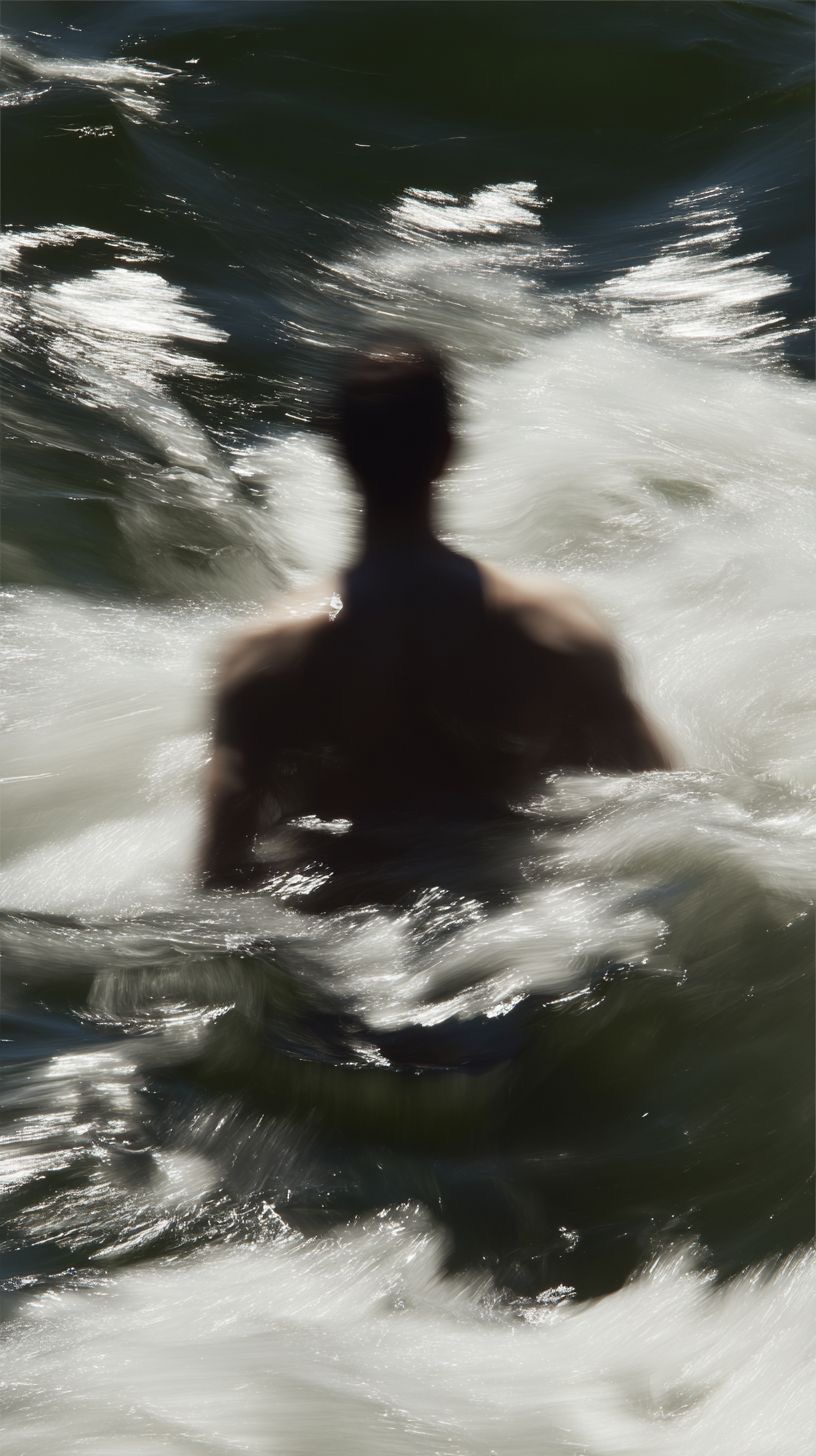
There is a particular kind of frustration that appears when someone first tries to move well in water. They try harder. The breathing becomes urgent, the legs kick more aggressively, the arms pull with greater force, and the whole body begins working to escape the feeling of losing control.
Then they slow down.
Water makes this contradiction unusually easy to feel, because the medium responds immediately to what you do inside it. Extra motion changes the flow around the body. Poor timing creates resistance. Tension that remains after it has stopped being useful becomes something the body then has to overcome.
A review of 75 studies on swimming drag puts a number on that experience 1.
Researchers distinguish between passive drag, the resistance encountered when a rigid body is towed through water, and active drag, the resistance encountered while that body is actually swimming. Across the heterogeneous methods summarized in the review, active drag and its coefficient were reported at roughly 1.5 to 2 times their passive equivalents.
That range is not a physical constant, and the review's own central complaint is that measurement methods disagree with one another. The direction is still striking. The body begins moving, and the resistance increases. Some of the water a swimmer ends up fighting was organized by their own attempt to move through it.
Which makes water an unusually useful place to study the relationship between effort and skill.
Where the work goes
A 1988 experiment involving four top class swimmers examined what happened to mechanical power during front crawl 2. The researchers estimated propelling efficiency between 46 and 77 percent. A meaningful portion of the mechanical work produced by highly skilled swimmers accelerated the surrounding water rather than overcoming the drag acting on the swimmer.
Those exact values come from four men on an arms only experimental apparatus and should stay inside that context. The underlying problem is fundamental to locomotion through any fluid. Generating force is only part of the task. The force has to be organized so that it moves the body rather than simply moving the environment around it.
This distinction is easy to lose in training, because effort is so visible. We can see someone strain, count repetitions, measure force, reward intensity. Efficiency tends to appear as an absence. The unnecessary contraction never happens. The limb stops pushing at the right moment. The body creates less disturbance.
The moment a muscle switches off
One Japanese study makes that almost unnervingly literal 3.
Researchers compared ten competitive swimmers with ten recreational swimmers performing flutter kicks in a swimming flume, recording kinematics alongside activity in the rectus femoris and biceps femoris.
From the outside, the kicking patterns were remarkably similar. The kinematic data did not differ between the groups.
The distinction appeared in the timing of muscular release. Recreational swimmers kept the rectus femoris active until roughly 47 to 48 percent of the kick cycle. Competitive swimmers switched it off around 26 to 33 percent.
Sit with how strange that is. Two swimmers produce a visually similar movement. One of them holds a muscle on for nearly twice as long before releasing it, during which the quadriceps is still firing while the hamstring is beginning to contribute, and the leg is briefly working against itself. None of this is visible to a coach on the deck. None of it is easy for the swimmer to feel or to describe. And it is one of the clearest markers separating the two groups.
The study did not measure the energy cost of that overlap, and because the design was cross sectional it cannot establish that swimming practice caused the difference rather than selecting for people who already had it. The important observation survives both limitations. A strong distinction between skilled and unskilled appeared in when effort ended.
That gives us a far more precise way to think about relaxation.
Relaxation is usually spoken about as a global state. A coach says relax, and the athlete is somehow supposed to reduce unnecessary tension everywhere at once, by deciding to. The swimmers in this study suggest something much more technical. Release is a timing skill. It happens inside a fraction of a movement cycle, on a timescale far below deliberation, invisible to an observer and largely unavailable to introspection.
This helps explain why the instruction so often fails. A decision being made in tens of milliseconds, several hundred times in a session, by a system that takes no verbal input, will not be reached by a cue aimed at conscious attention. What reaches it is repetition inside a medium that charges immediately for getting it wrong, which is a description of water.
Skill here arrives as a subtraction, correctly timed.
The water remembers what you just did
Another Japanese experiment examined the hand 4.
A skilled swimmer performed sculling movements in a controlled water channel while researchers measured three dimensional hand motion, pressure distribution, and the surrounding flow field. The study involved a single skilled swimmer, so it demonstrates that a mechanism exists and can be exploited rather than establishing how much it contributes at racing speed.
What the researchers observed is still remarkable. Propulsive forces emerged through unsteady fluid phenomena including a leading edge vortex on the back of the hand and wake capture on the palm side. Wake capture occurs when the hand reverses into water it has already disturbed and uses the resulting flow structure to generate force. The authors noted these resemble phenomena seen in flying insects.
The swimmer is interacting with the consequences of an action that happened moments earlier.
This is what experienced swimmers mean by developing a feel for the water, and the phrase stops sounding mystical once it is translated into physics. The hand operates inside a changing medium, every movement alters what the next movement will encounter, and skill involves perceiving those changing conditions quickly enough to use them. The task contains memory. Propulsion arrives through cooperation with water the swimmer has already set moving.
Perception and action form a loop, and the environment keeps changing because the performer keeps changing it.
The same water, a different nervous system
The difference between expertise and inexperience also appears upstream of the muscles.
A 2020 experiment compared 14 elite competitive swimmers with 14 novices using transcranial magnetic stimulation before, during, and after water immersion, examining intracortical inhibition, part of the inhibitory circuitry operating inside primary motor cortex 5.
When immersed, the two groups moved in opposite directions. Intracortical inhibition at rest increased in the swimmers and decreased in the nonswimmers, relative to land. The swimmers also held their sensorimotor accuracy more consistently across the transitions between environments.
The researchers were appropriately careful, and their caution is worth repeating rather than burying. They stated explicitly that the observed differences in cortical inhibition were insufficient to account for the swimmers' superior sensorimotor performance. The design was cross sectional, so it cannot tell us whether years of swimming produced the neural pattern or whether certain people were more likely to become elite swimmers.
The useful observation is narrower and still worth having. The water was the same. The nervous systems entering it were not. Experience changed how the environment was met, and the trained response involved inhibiting more rather than driving harder.
What the pattern suggests
Across these studies, expertise repeatedly appears as control of unnecessary output. Lower drag coefficients as technical efficiency rises. Earlier muscular release. The exploitation of flow that already exists. Greater cortical inhibition in the trained group.
No one of these studies provides a theory of swimming expertise, and together they still do not. What they make difficult to avoid is a specific claim, worth stating plainly rather than hedging:
In an environment that charges immediately for unnecessary output, skill develops largely through subtraction, and the subtraction is invisible from outside.
That is a claim about what happens in a medium with fast, proportional, unambiguous feedback. Which is why the next part matters, because most of what is currently sold to us under the heading of water works differently.
The same error, sold back
Swimming is only one way the modern body meets water. Another has become an industry. Cold plunges, contrast therapy, saunas, recovery clubs, and temperature based wellness have turned water into an intervention, marketed largely through the intensity of the experience itself.
This produces a strange reversal. In the pool, unnecessary effort manufactures resistance. In recovery culture, an added intervention can interfere with a process that was already running.
A 2025 study made that visible through an unusually strong design 6.
Twelve healthy young men completed one resistance training session. Immediately afterward, one leg was immersed in 8°C water and the other in 30°C water for twenty minutes, so each participant served as his own control. Afterward the men consumed 20 grams of amino acids labeled with a stable isotope tracer, which let the researchers follow where those amino acids went.
Microvascular blood volume in the cooled leg fell sharply relative to the warmer leg, and dietary amino acid incorporation into muscle tissue across the measured four hour window was roughly 30 percent lower.
Same man. Same session. Same drink. Same four hours. The only variable was the temperature of the water each leg sat in, which means sleep, food, genetics, and motivation cannot explain the gap.
Read the result narrowly. Twelve men, one session, one immediate cooling protocol, one four hour window. Nothing here measures muscle size over a training block, so the finding cannot support a claim that cold plunges reduce long term growth by 30 percent. What it does support is more specific and more useful: immediate cooling at this dose substantially reduced muscle microvascular perfusion and reduced how much of the ingested material reached the tissue.
The cold narrowed the road the building material had to travel. A large fall in microvascular perfusion carries no sensation at all, while the cold itself feels like the most decisive thing that happened all day.
What the training literature actually says
The broader hypertrophy literature is more cautious than the headlines built on it.
A 2024 systematic review with Bayesian meta analysis included eight studies of immediate post exercise cold water immersion and resistance training induced hypertrophy 7. The estimated contrast favored training without cold immersion, with a standardized effect of approximately negative 0.22 and a 95 percent credible interval running from negative 0.47 to 0.04.
The authors concluded that immediate cold water immersion may attenuate hypertrophic changes, and explicitly flagged the quality of the underlying evidence. Three of the eight studies were rated fair, five were rated poor, and none was rated good. Because the analysis was Bayesian, describing the result as statistically significant would be incorrect.
That wording matters, and stating the interval out loud costs a dramatic number while buying the only thing that compounds. A modest attenuation with a plausible mechanism is already interesting. The evidence does not have to become a catastrophe to deserve attention.
The fake laser
The most revealing recovery study has almost nothing to do with temperature 8.
Researchers randomized national level academy soccer players to cold water immersion, hot water immersion, or a sham laser device that looked like a legitimate recovery treatment and emitted no functioning laser. Forty players completed the acute component, and nineteen continued their assigned modality twice weekly for fifteen weeks.
Across the 21 to 45 hour recovery window after a simulated match, all three interventions affected recovery similarly. Across the longer training period, neither cold nor hot immersion produced an advantage in body composition or physical performance development.
The placebo is what makes this experiment matter. Doing nothing is a poor control for a dramatic ritual. An athlete sitting in ice water receives attention, novelty, expectation, sensation, and an unmistakable feeling that recovery is occurring. A convincing fake treatment controls for some of that. When all three groups recover similarly, part of what looked like it belonged to the water may belong instead to the experience surrounding it.
This is a standard worth applying to every recovery product, and once you have it you no longer need anyone to adjudicate the next one for you. Whenever a treatment produces a strong sensation, ask what happened when it was compared against an equally convincing ritual rather than against nothing.
One precision note belongs here, because the category collapses three different things. Water does something to you before any intervention begins. Nine young men stood immersed to right atrial level in 30°C water, and heart rate fell from 78 to 62 beats per minute while stroke volume rose from 62 to 82 millilitres and cerebral blood velocity increased 9. Hydrostatic pressure shifts blood centrally, and chest compression raises carbon dioxide, which is what dilates the cerebral vessels. That was thermoneutral water. Immersion is one thing, temperature is a second, exercise is a third, and the marketing routinely fuses all three into the single word water.
Heat, and the difference between association and mechanism
Sauna research shows the same problem from another angle.
Large Finnish observational cohorts have reported associations between frequent sauna bathing and favourable cardiovascular outcomes, which is much of why sauna became a longevity fixture.
A randomized trial asked the narrower mechanistic question 10. Forty one adults with stable coronary artery disease were assigned to an eight week intervention, with the sauna group completing four sessions per week at roughly 79°C. The participants adapted to heat, with resting core temperature falling and sweat rate rising. Vascular function did not improve. Flow mediated dilation, carotid femoral pulse wave velocity, and blood pressure showed no significant intervention effect.
A 2025 review of twenty randomized passive heating trials landed similarly, finding no clear pooled effect on several major vascular and metabolic measures, with blood pressure reductions appearing in specific subgroups, notably systemic heating studies and people with existing cardiovascular risk 11.
None of this erases decades of observational research. An eight week trial cannot refute a forty year habit, and nobody should pretend otherwise. What changes is the explanation. A lifelong cultural practice in a country where it is close to universal will track mobility, income, healthcare access, social participation, and dozens of behaviours that travel alongside it. The randomized data tell us the mechanism everybody repeats has not been demonstrated as cleanly as the popular story implies.
The subgroup result says something quietly useful too. The people it moved were the ones with something already wrong. Interventions that correct a deficit look powerful in the deficient and inert in the healthy, which is much of what separates a clinical finding from a wellness product.
The gap between the claim and the evidence
Water related wellness sits inside a larger environment where claims travel faster than the evidence under them. Several examples surfaced while researching this letter.
Claims that an FDA committee approved a group of longevity peptides exceed what can be verified. The meeting and its agenda are confirmed in the Federal Register 15. The vote outcomes circulating publicly could not be confirmed through any reachable primary source. Even a confirmed favourable vote would remain advisory, and placement on a list of substances eligible for compounding is some distance from a drug approval.
A small uncontrolled study of twelve young men in water below 4°C found testosterone decreased immediately afterward while remaining inside normal reference ranges 12. That is a long way from evidence that cold exposure durably raises or lowers testosterone in either direction.
A 2026 glucose study frequently discussed alongside cold plunging did not use water at all 13. Participants wore a refrigerated liquid conditioned suit. The modest effect appeared in participants with type 2 diabetes under the milder 15°C condition, and the colder 4°C condition was null.
A 2026 paper reported that whole blood NAD+ levels remained remarkably stable across age and across lifestyle interventions in seven independent human cohorts, complicating the premise that declining whole blood NAD+ offers a simple biomarker of human aging 14. It says nothing definitive about tissue NAD+ or about whether any precursor supplement produces a clinical effect.
The pattern is familiar. A real observation appears. A mechanism is proposed. A market converts the mechanism into a promise. The promise becomes more memorable than the experiment. Scientific literacy increasingly means knowing which stage of that sequence you are looking at.
A swimmer in a waterfall
The science is recent. The problem is not.
In chapter 19 of the Zhuangzi, an Outer Chapter compiled during the Warring States period, Confucius encounters a violent cataract described as too dangerous for even aquatic animals 16. He sees a man enter the current and assumes he is watching a death. The man later emerges and walks along the bank singing.
Asked how he survives the water, he starts with a remarkable answer. I have no way.
He then describes the history of his competence rather than its method. He began in the circumstance early. Growing up inside it made the practice his nature. Eventually success became as dependable as fate. His operating principle is rendered by James Legge as: I follow the way of the water, and do nothing contrary to it of myself.
The text is doing something sophisticated. The swimmer has extraordinary skill and cannot package it into anything transferable. Competence exists without a complete account of itself, and the text treats that as the mark of the real thing rather than as a gap in it.
Which is close to what the flutter kick study found. The difference between the two groups lived in a release timing nobody could see and the swimmer could not have described.
Set that beside a line from chapter 78 of the received Daodejing, where Legge renders the closing clause as: every one in the world knows that the soft overcomes the hard, and the weak the strong, but no one is able to carry it out in practice 17.
Knowledge and embodiment are different achievements. That sentence has been continuously available for roughly twenty four centuries, in every bookshop, and it has changed nobody, because a sentence about the insufficiency of sentences is still a sentence. A description of surrender can be perfect. The body still has to learn when to stop fighting the current, and it learns that only somewhere the mistake costs something immediately.
A civilization organized around redirecting water
Chinese political mythology extends the same problem from the body to the state.
The Great Flood narratives contrast two approaches. Gun attempts to contain the flood through blocking and embankment and fails. His son Yu succeeds through drainage and redirection, and the mandate to rule follows from that competence.
The failure mode is the interesting part, because it involves no lack of effort or resources. Gun had the most powerful substance in the myth and applied it directly to the problem, which is precisely why he failed. Opposition at that scale generates the disaster it was meant to prevent.
The historical relationship between a major flood around 1920 BCE and the Xia remains contested. A 2016 paper argued that geological evidence supported the historicity of a catastrophic outburst flood, and it drew a published Comment and a published Response 18. The mythology should stay mythology and the geology should stay a live scientific debate.
The engineering that followed is easier to verify. Around 256 BCE the Dujiangyan irrigation system was built on the flood prone Min River. UNESCO describes it as using natural topographic and hydrological features to divert water, drain sediment, control floods, and regulate flow without the use of dams 19. Its three components divide and redirect the river through the landscape, and it still irrigates hundreds of thousands of hectares. It has been rebuilt and modernized repeatedly, so calling it physically unchanged for two thousand years would be false. Continuous operation is impressive enough, and everything built to fight that river is gone.
The parallel to training is not decorative. A coach does not have to defeat an athlete's existing strategy through endless verbal correction. A task can be redesigned until the useful solution becomes the easiest one to find, and the body then takes a different path because the environment gives it somewhere else to go.
When the material is allowed to act
Bill Viola spent much of his career using water as a threshold between states of being.
In Ocean Without a Shore, created for the church of San Gallo during the 2007 Venice Biennale, figures approach from darkness, cross a boundary, become fully present, and eventually withdraw. On screen the boundary looks almost supernatural. It was physical. A National Gallery of Victoria catalogue essay confirms that the threshold was an actual sheet of cascading water rather than a digital effect 20.
That material decision changes the performance. A rendered waterfall asks the performer to act as though something happened. Real water produces an involuntary response. The breath changes, the eyes close, the body hesitates, the clothing changes, and the nervous system encounters an event before anyone has time to interpret its symbolism.
Viola could have rendered it. Rendering would have looked cleaner, cost less, and read as the same image to any viewer who did not know. He used water because the medium had to participate.
That principle travels well past art. When every obstacle is removed from a learning environment, some of the information responsible for adaptation leaves with it. A medium that stops resisting stops installing anything.
Who still has somewhere to practice
The commercial expansion of premium water experiences sits alongside a contraction in public access.
According to Swim England and ukactive, Britain lost exactly 500 swimming pools between 2010 and June 2025, representing 34,859 square metres of water space 21. Seventy six percent of the lost water space disappeared after 2020. Separately, 42 percent of the pools lost since 2010 closed in that same period. Those two percentages measure different things and should not be swapped. Sport England reported that in the 2023 to 2024 academic year, 30 percent of Year 7 children could not swim 25 metres competently, confidently, and proficiently, up from 27 percent in 2017 to 2018.
Swimming is sport, training, recreation, and therapy. It is also a basic physical capacity whose transmission depends on access to an environment, and a society can lose a movement skill when the places that teach it disappear.
History has already run this experiment. In 1587 Everard Digby published De arte natandi libri duo, one of the earliest substantial printed swimming manuals in England, with dozens of illustrations 22. The existence of the manual is the revealing part. Swimming had to be formalized as an art, with named techniques written down, because it was no longer transmitted by default.
Movement cultures are built. They can also erode.
What subtraction actually means
The claim earlier deserves an answer rather than an open ending.
In an environment with fast, proportional, unambiguous feedback, skill develops largely through subtraction. The evidence here is specific. Drag coefficients fall as technical efficiency rises. The clearest marker between skilled and unskilled kicking was releasing a muscle earlier. The propulsive mechanism involves using flow that already exists. The trained brain met the water by inhibiting more.
Two honest limits belong on that claim.
The first is that these studies are small and mostly cross sectional. Four men on an arms only apparatus. One swimmer in a flume. Twenty swimmers and two muscles. Fourteen per group, with the authors themselves ruling out their headline finding as the explanation. Each is a piece of a picture, none is proof, and the convergence is the interesting thing rather than any single result.
The second limit concerns transfer, because this would be easy to oversell. A 2024 review comparing aquatic and land based exercise in older adults found a large advantage for water on one balance scale, with extremely high heterogeneity, and no clear advantage on functional walking measures 23. A 2026 review of 19 trials and 866 older adults found real improvements in strength and mobility from aquatic exercise while measuring no falls, fractures, hospitalizations, or deaths 24. Improved performance on a surrogate test cannot become a claim that aquatic exercise prevents falls. Water teaches capacities. What comes back to land with you has to be measured rather than assumed.
What generalizes is the property the pool has.
A useful training environment charges immediately, proportionally, and unambiguously for the wrong response. Land defers the bill by weeks and mixes it with sleep, food, stress, and everything else, which is why so much time spent training teaches so little. Understanding fails to transfer into behaviour because understanding has never once been charged for being wrong.
Water is difficult to lie to. Push badly and the drag arrives. Hold a contraction past its usefulness and the limb starts opposing itself. Disturb the medium and your next action inherits the consequences. Enter it and hydrostatic pressure changes your circulation before intention enters the conversation.
That is worth more than the calories it burns.
The next time you get in, resist turning the session immediately into a test of fitness. Take one length. Move slowly enough to notice the consequences of what you do. Find where tension is still present after it has finished helping, and which movements disturb a lot of water without moving you very far. See whether your hand can feel the flow left by its own previous action. Then try removing effort instead of adding it, and watch what happens to your speed.
That is the whole experiment, and it takes about four minutes.
How much of the resistance in front of you belongs to the problem, and how much was created by the way you entered it?

References
- [1] Tiago J. Lopes, Jorge E. Morais, Marcos P. Pinto, Daniel A. Marinho (2022). Numerical and experimental methods used to evaluate active drag in swimming: A systematic narrative review. Frontiers in Physiology.
- [2] Huub M. Toussaint, Ate Beelen, Aart Rodenburg, Anthony J. Sargeant, Gert de Groot, A. Peter Hollander, Gerrit Jan van Ingen Schenau (1988). Propelling efficiency of front-crawl swimming. Journal of Applied Physiology.
- [3] Yuji Matsuda, Masahiro Hirano, Yasuo Yamada, Yasuhiro Ikuta, Takeshi Nomura, Hiroaki Tanaka, Shingo Oda (2016). Lower muscle co-contraction in flutter kicking for competitive swimmers. Human Movement Science.
- [4] Hideki Takagi, Shohei Shimada, Takahiro Miwa, Shigetada Kudo, Ross Sanders, Kazuo Matsuuchi (2014). Unsteady hydrodynamic forces acting on a hand and its flow field during sculling motion. Human Movement Science.
- [5] Daisuke Sato, Yudai Yamazaki, Koya Yamashiro, Hideaki Onishi, Yasuhiro Baba, Koyuki Ikarashi, Atsuo Maruyama (2020). Elite competitive swimmers exhibit higher motor cortical inhibition and superior sensorimotor skills in a water environment. Behavioural Brain Research.
- [6] Milan W. Betz, Cas J. Fuchs, Floris Chedd, Annabelle P. Monsegue, Floris K. Hendriks, Lex B. Verdijk, Luc J. C. van Loon, Tim Snijders (2025). Postexercise Cooling Lowers Skeletal Muscle Microvascular Perfusion and Blunts Amino Acid Incorporation into Muscle Tissue in Active Young Adults. Medicine and Science in Sports and Exercise.
- [7] Alec Piñero, Ryan Burke, Francesca Augustin, Adam E. Mohan, Paul A. Swinton, Brad J. Schoenfeld (2024). Throwing cold water on muscle growth: A systematic review with meta-analysis of the effects of postexercise cold water immersion on resistance training-induced hypertrophy. European Journal of Sport Science.
- [8] Jesper Gustafsson, Diego Montiel-Rojas, Mattias G. A. Romare, Thomas Chaillou, Peter Edholm (2025). Cold- and hot-water immersion are not more effective than placebo for the recovery of physical performance and training adaptations in national level soccer players. European Journal of Applied Physiology.
- [9] Howard H. Carter, Angela L. Spence, Christopher J. A. Pugh, Philip Ainslie, Louise H. Naylor, Daniel J. Green (2014). Cardiovascular responses to water immersion in humans: impact on cerebral perfusion. American Journal of Physiology, Regulatory, Integrative and Comparative Physiology.
- [10] Amelie Debray, Hugo Gravel, Laurence Garceau, Georgia K. Chaseling, Audrey Nigam, Martin Juneau, Daniel Gagnon (2023). Finnish sauna bathing and vascular health of adults with coronary artery disease: a randomized controlled trial. Journal of Applied Physiology.
- [11] Rikuta Hamaya, Yasutaka Joyama, Takahiro Miyata, Howard D. Sesso (2025). Non-acute effects of passive heating interventions on cardiometabolic risk and vascular health: systematic review and meta-analysis of randomized controlled trials. American Journal of Preventive Cardiology.
- [12] Aneta Teległów, Iwona Cicha (2025). Single immersion in cold water below 4 °C: A health hazard in young healthy men?. PLOS ONE.
- [13] Dzhansel Hashim, Julia A. Jörgensen, Tineke van de Weijer, Denis P. Blondin, Patrick Schrauwen, Joris Hoeks (2026). Acute mild cold exposure with shivering reduces 24 h glucose levels in individuals with type 2 diabetes but not prediabetes. Diabetologia.
- [14] Maria M. Trętowicz, Angelique M. L. Scantlebery, Bauke V. Schomakers, Riekelt H. Houtkooper (2026). Human whole-blood NAD+ levels do not vary with age or lifestyle interventions. Nature Metabolism.
- [15] US Food and Drug Administration (2026). Pharmacy Compounding Advisory Committee, Notice of Meeting: Bulk Drug Substances Nominated for Inclusion on the Section 503A Bulk Drug Substances List. Federal Register, document 2026-07361.
- [16] Translated by James Legge, The Texts of Taoism, Sacred Books of the East volumes 39 and 40 (1891). Zhuangzi, Outer Chapters, chapter 19, Da sheng. Oxford University Press.
- [17] Translated by James Legge (1891). Daodejing, received text, chapter 78. Oxford University Press.
- [18] Qinglong Wu, Zhijun Zhao, Li Liu, Darryl E. Granger, Hui Wang, David J. Cohen (2016). Outburst flood at 1920 BCE supports historicity of China's Great Flood and the Xia dynasty. Science.
- [19] UNESCO World Heritage Centre (2000). Mount Qingcheng and the Dujiangyan Irrigation System, World Heritage List reference 1001. UNESCO.
- [20] Alex Baker (2014). Bill Viola: Ocean Without a Shore. National Gallery of Victoria.
- [21] Swim England and ukactive (2025). Pace of swimming pool closures increasing. Swim England.
- [22] Everard Digby (1587). De arte natandi libri duo. Thomas Dawson, London.
- [23] Ying Deng, Zhen Tang, Zhi Yang, Qian Chai, Yongzhao Zhou (2024). Comparing the effects of aquatic-based exercise and land-based exercise on balance in older adults: a systematic review and meta-analysis. European Review of Aging and Physical Activity.
- [24] Yang Gao, Wei Deng, Qing Zeng, Lin Hao, Hui Li (2026). Effects of aquatic exercise on improving body composition and muscle strength in the older adults: a systematic review and meta-analysis of randomized controlled trials. Frontiers in Public Health.
A return to awareness.
Someone forwarded this to you? Research goes out every week.
Opens Messages with the word ready. Or text JOIN to (303) 570 5060 yourself.
One Research letter a week by text. Message and data rates may apply. Reply STOP at any time to end. To come back after that, text START to (303) 570 5060.
From phorme
Research is where the ideas are explored. phorme is where they become practice. Thirty dollars a month, cancel at any time. Join